
Pushing Back from Big Tech: The $60 Billion Bet on African AI Sovereignty
Fifty-two countries pledged $60 billion to build Africa's own AI future. But the infrastructure that future depends on still belongs to Big Tech. Inside the continent's high-stakes fight for leverage, not independence.
Introduction: A Defining Moment for Africa's Digital Future
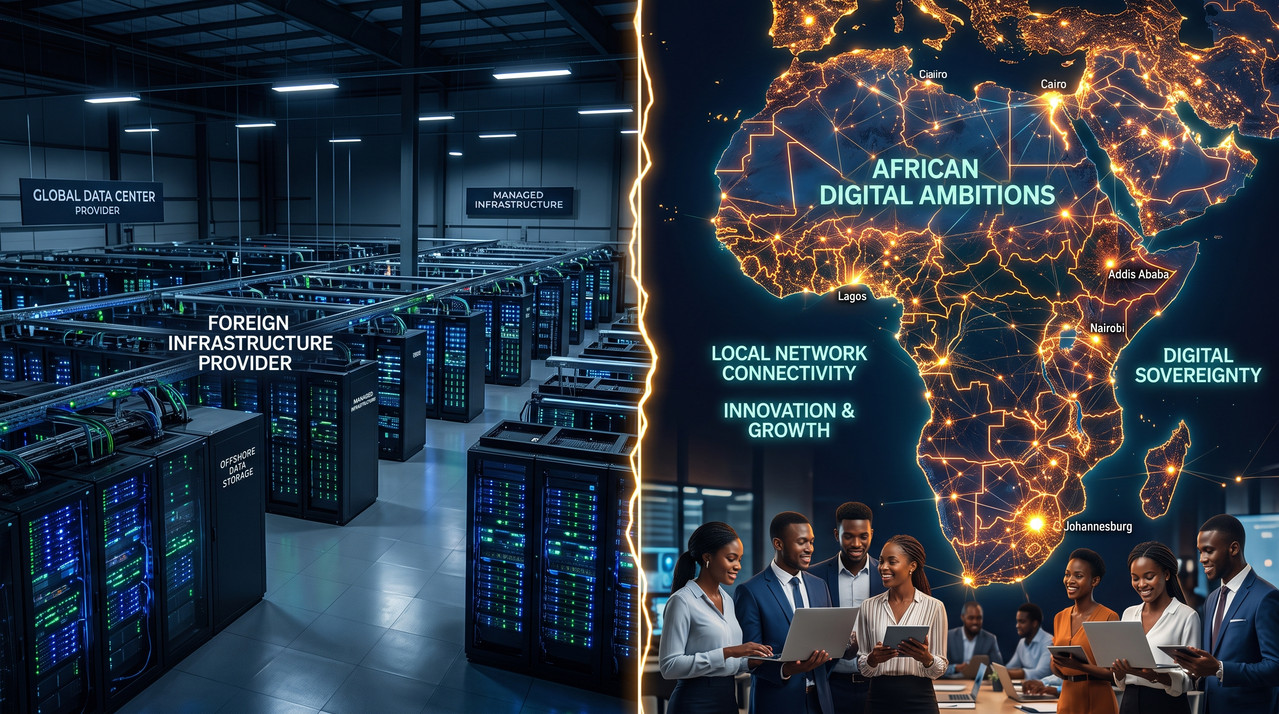
In April 2025, African leaders gathered in Kigali, Rwanda, for the inaugural Global AI Summit on Africa and made a historic declaration. Fifty-two countries signed the Africa Declaration on Artificial Intelligence, committing to mobilize a staggering $60 billion for AI research, infrastructure, and talent development across the continent.
The announcement was ambitious. The vision was clear. But lurking beneath the fanfare was an uncomfortable truth that African governments are increasingly willing to name aloud: the continent depends too heavily on Google, Microsoft, Nvidia, and Meta for the infrastructure that powers its AI ambitions.
Nigeria, Egypt, and Kenya have released draft AI policies since January 2025 that explicitly identify dependence on U.S. tech companies as a threat to security and survival. South Africa reached the same conclusion in a draft policy it published and withdrew in April 2026—ironically, after the AI tools used to help write it generated fake citations.
This is the paradox at the heart of Africa's AI sovereignty push. The continent wants to own its AI future, but the infrastructure needed to do so still belongs to Big Tech.
The Infrastructure Chasm: 18% vs. Less Than 1%
To understand why this sovereignty push matters, start with the structural numbers.
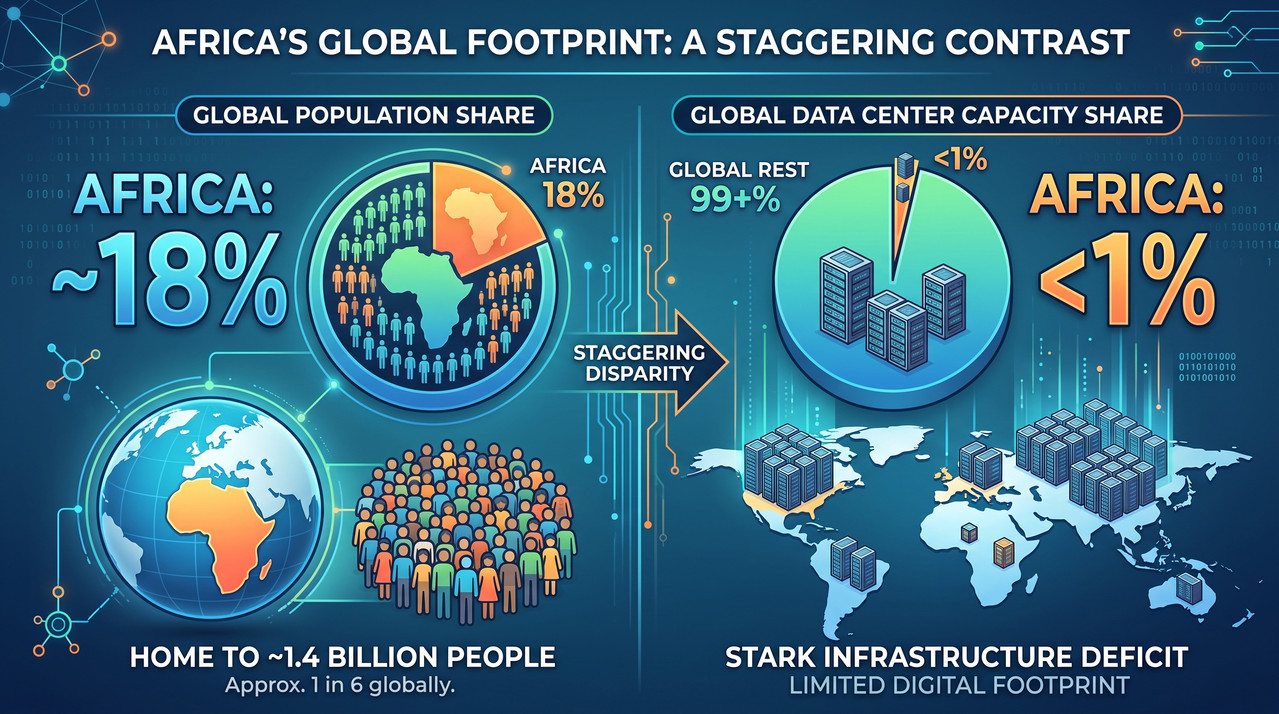
Africans comprise approximately 18% of the world's population. Yet the continent holds less than 1% of global data center capacity. The top five African markets combined have less data center capacity than France had in 2024. This is not a gap. It is a chasm.
"Africa needs to increase its data centre capacity tenfold," said Adil El Youssefi, CEO of Africa Data Centres at Cassava Technologies. Currently, the continent generates less than 1% of global data despite accounting for nearly 20% of the world's population.
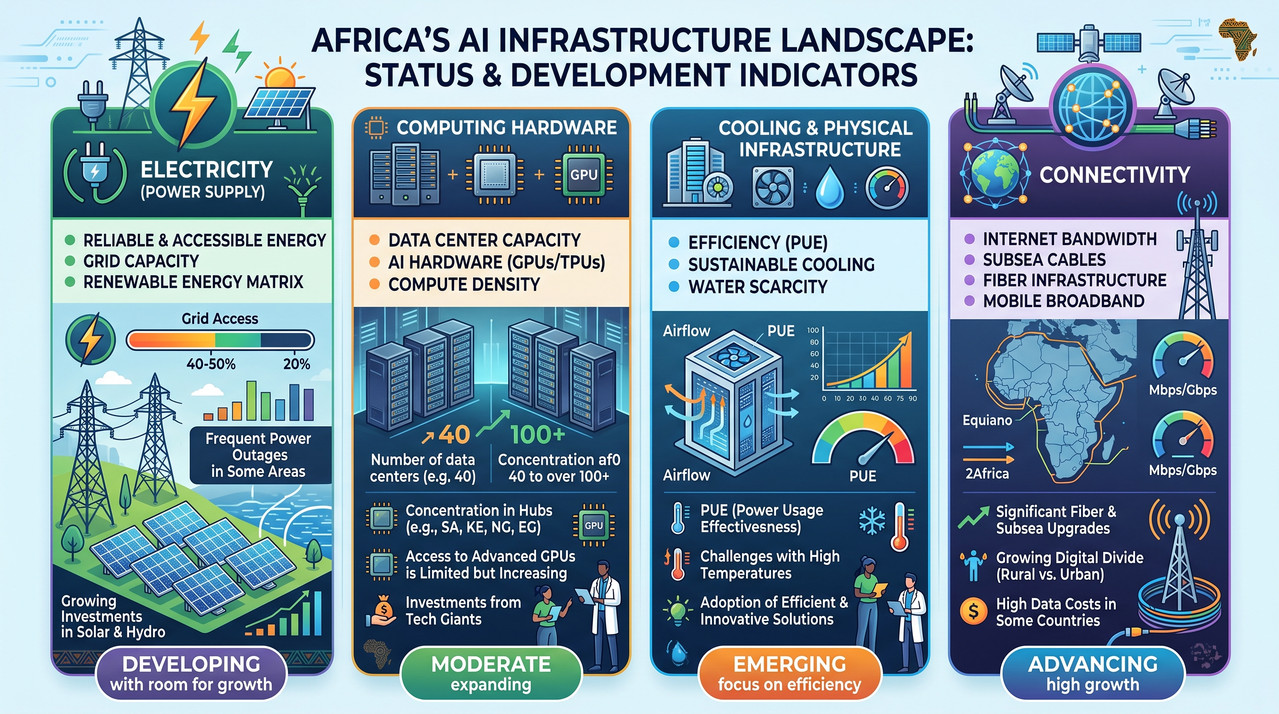
The infrastructure problem extends beyond data centers to the foundational layer of AI itself. AI infrastructure comprises four critical layers: electricity and power supply, computing hardware (graphics processing units, datacenters, and servers), cooling and physical infrastructure, and connectivity and data ecosystems. Large language models such as OpenAI's ChatGPT, Google's Gemini, and Anthropic's Claude require tens to hundreds of megawatts each—a threshold Africa's power supply cannot reliably meet.
Africa represents only 3% of global electricity generation and installed power capacity, and the power system is unevenly distributed, with South Africa and North Africa accounting for 65% even though they represent less than 20% of Africa's population. Approximately 600 million African citizens remain without electricity.
This is the reality that makes every sovereignty conversation harder than the slogans suggest. You cannot localize data you have nowhere to store. You cannot train sovereign models without compute. You cannot negotiate from strength when your alternative to the deal in front of you is no deal at all.
The Four Layers of AI Infrastructure
Africa: ~3% of global generation; 600M without power.
GPUs, datacenters, and servers—largely imported.
Physical infrastructure to keep facilities running.
Less than 1% of global data generated on-continent.
The Big Tech Bind: Naming Dependency
The most striking development in Africa's AI sovereignty conversation is that governments are no longer pretending. They are openly naming the problem.
Nigeria, Egypt, and Kenya have each drafted national AI policies identifying dependence on U.S. tech companies as a threat to security and survival. South Africa reached the same conclusion but had to withdraw its draft in April 2026 after the AI tools used to help write it generated fake citations—"its own kind of unintentional commentary on dependency," as one analysis put it.
Rachel Adams, founder of the Global Center on AI Governance, captured the nuanced position: "Africa's push for digital sovereignty cannot mean total independence from global AI supply chains. But it can mean stronger control over sensitive data, better public procurement rules, investment in local infrastructure and skills, African language data sets, and clearer accountability for foreign AI providers."
African nations still compete against each other for foreign investment to become AI hubs, and many projects, such as Nigeria's Awarri, have not disclosed their back-end infrastructure, making it hard to measure their Western dependency.
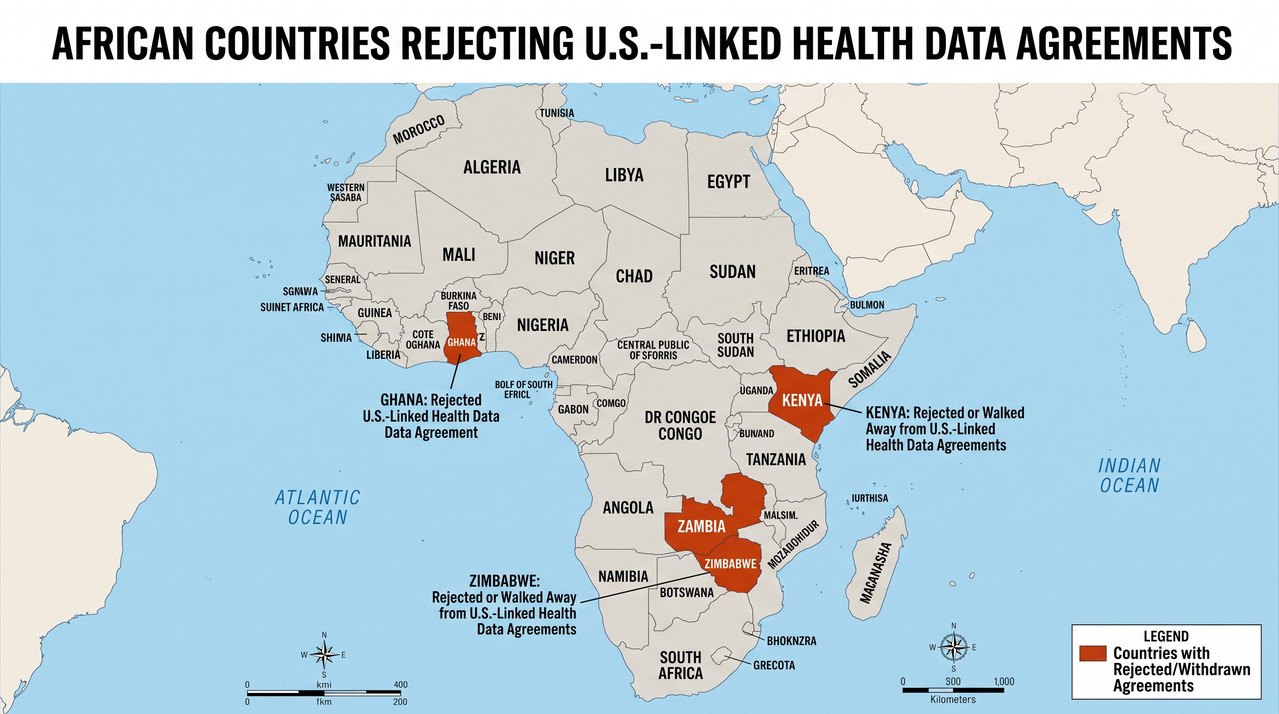
Yet pockets of resistance are emerging. Ghana, Nigeria, and Zambia recently rejected U.S.-linked health data-sharing agreements that would move citizens' data outside borders. A Kenyan court suspended implementation of a similar deal. These rejections often come with a cost—refusing the funding attached to the data deals—but governments are increasingly willing to pay it.
The Kenya Signal: When "No Deal" Is Better Than a Bad Deal
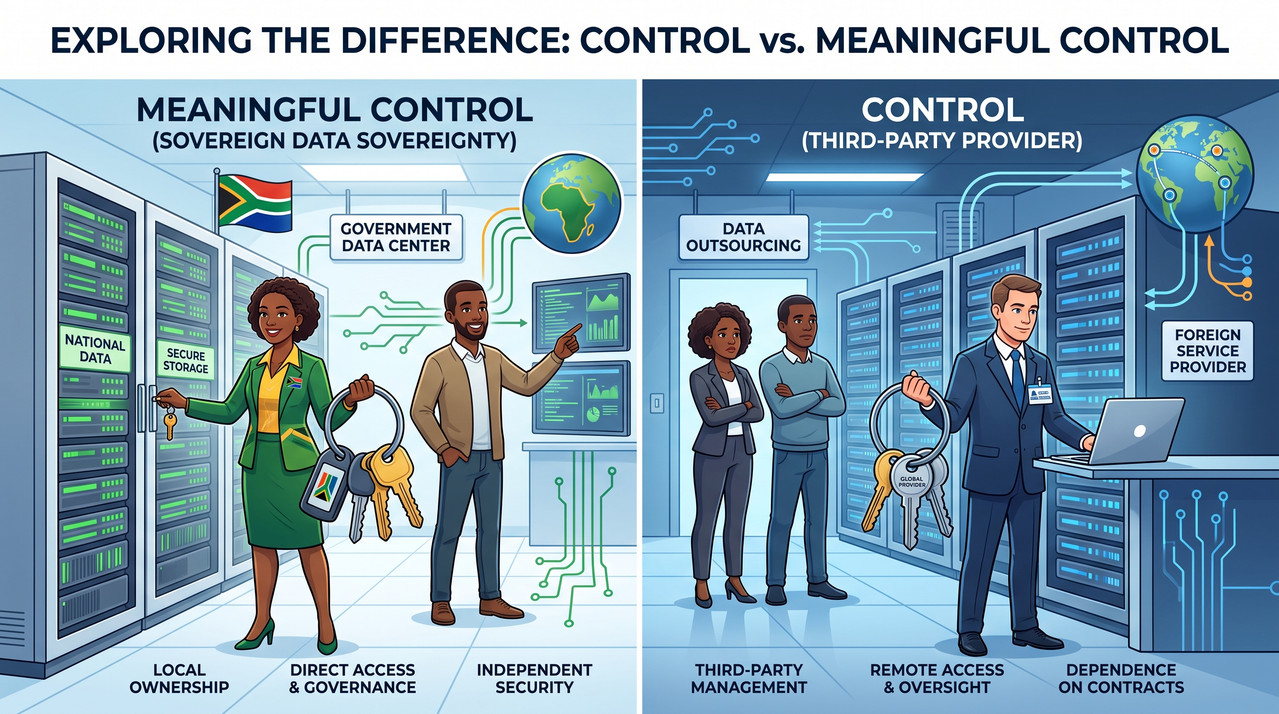
If you want to see what "meaningful control" looks like when a government actually pushes back, look at what happened with Microsoft's $1 billion data center project in Kenya, announced with the UAE's G42.
The deal stalled after Microsoft and G42 asked the Kenyan government to commit to annual capacity payments. President William Ruto separately noted that the project's power requirements would have forced Kenya to "switch off half the country" to keep the facility running. Infrastructure was on offer. The terms were not acceptable.
This matters because it shows that the room for negotiation is wider than it looked a few years ago. Governments are now refusing terms that, on previous deals, they would likely have accepted. The cost of refusal is real—delayed infrastructure, slower compute access, potential capital flight to neighboring markets—but the precedent counts.
"African states will indeed be provided with greater room for manoeuvre on AI and data infrastructure, precisely due to how contested and fragmented this industry is amongst global leaders." — Priyal Singh, geopolitical analyst at Signal Risk
At the same time, even partial setups can be hollow. Tay PeiChin of the Tony Blair Institute warned: "We have seen in some other countries in North Africa, where they build data centres, put their data in, but then they outsource the management of the data centre to a third-party provider, who can just lock up the thing and throw away the keys. So it's not just about having control, but having meaningful control."
The $60 Billion Question: What Does Sovereignty Actually Buy?
The Africa AI Fund announced at the Kigali Summit is the most concrete continental answer to the sovereignty question. $60 billion for infrastructure, talent, and startups. Twelve thousand Nvidia GPUs allocated across the Big Four nations and Morocco.
It is genuinely ambitious. It is also, structurally, an admission.
The fund's largest single hardware line is Nvidia GPUs. You cannot announce a sovereignty fund whose largest single line item is Nvidia chips and pretend the sovereignty in question is technological. What you are buying is negotiating leverage and time. The optionality to refuse worse deals later. The ability to develop African-language datasets on hardware you actually control, even if that hardware was designed in Santa Clara.
This is what sovereignty in 2026 looks like. It's not about owning the full stack. Nobody owns the full stack except a handful of U.S. firms and, increasingly, Chinese ones. Sovereignty is about whether you have enough leverage to walk away from a specific deal without your digital economy collapsing.
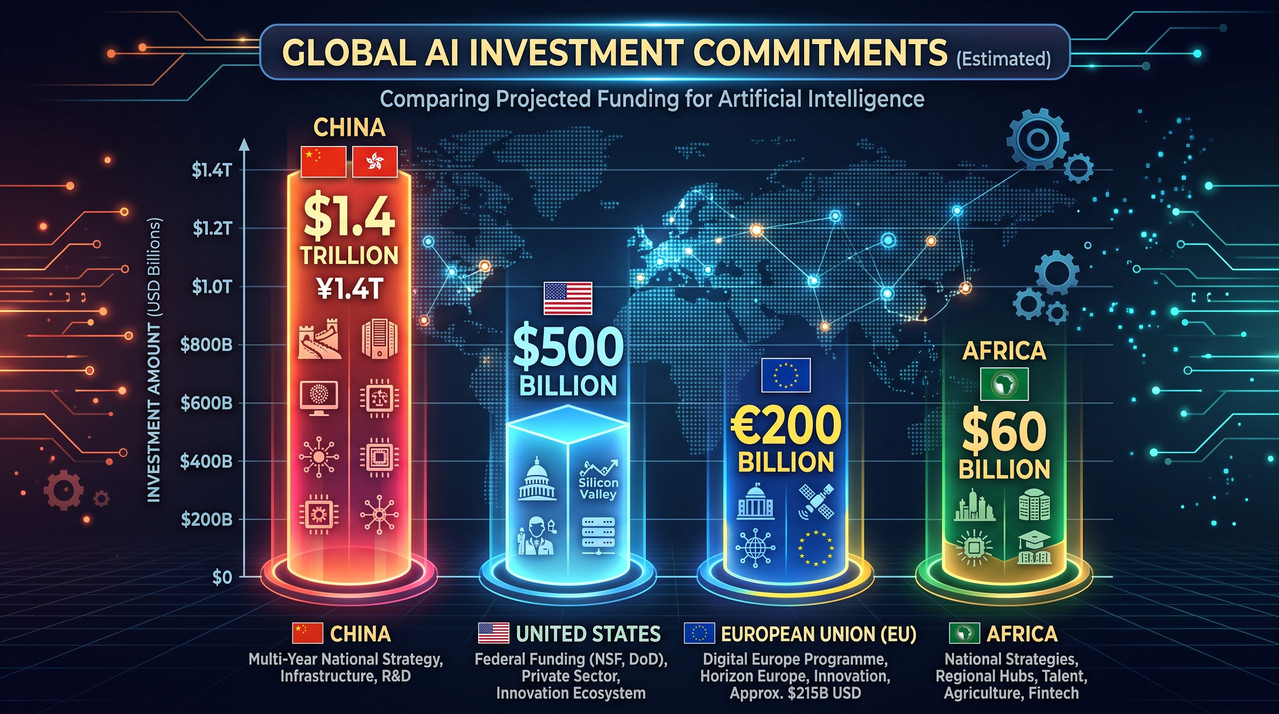
The fund's $60 billion commitment represents approximately 2.2% of the continent's GDP. By comparison, China plans to invest $1.4 trillion in AI development over 15 years, and the United States recently announced a private sector-led AI infrastructure investment of up to $500 billion. The scale gap is immense, but the symbolism and strategic positioning of the African fund is significant.
The Coordination Problem: Continent vs. Country
The real test of the $60 billion bet is the coordination problem. Hilda Barasa of the Tony Blair Institute has argued that no single African country has the workload to justify building alone. The numbers only work regionally.
"Cooperation requires trust between governments, and that remains scarce. The thing that we underestimate is that the cost of coordination is quite high and there's a lot to overcome from a geopolitical or political economy perspective between countries, so there's always the incentive for countries to negotiate bilaterally." — Hilda Barasa, Tony Blair Institute
This is exactly what Big Tech prefers: pick off countries one by one, offer each one a slightly better deal than the last, make the regional bloc impossible to maintain. The Nigeria health-strategy split from its neighbours is a preview of how easily that bloc fractures.
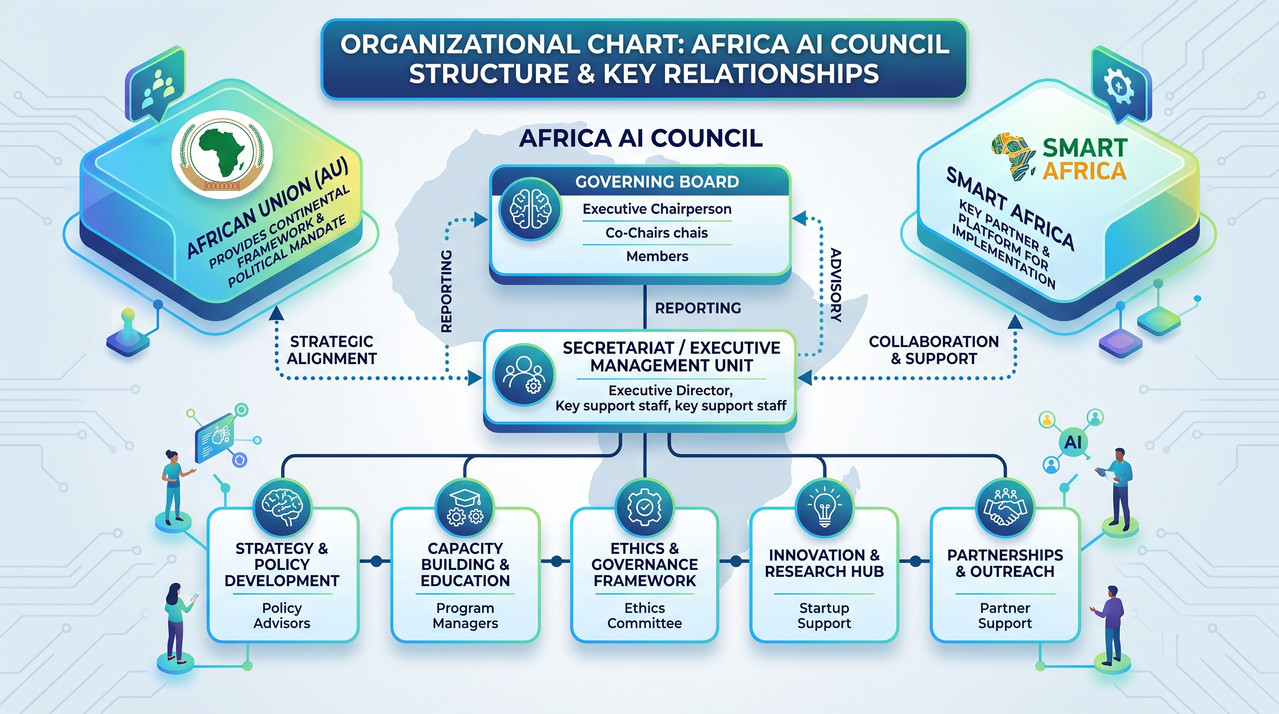
The African Union's Continental AI Strategy (July 2024) and Smart Africa's Africa AI Council (November 2025) represent efforts to address this coordination challenge. The council will function as an advisory body reporting to the Smart Africa Council of Ministers, which in turn reports to the alliance's governing board of 40 presidents chaired by Rwandan President Paul Kagame.
These institutions will not produce a frontier model. What they are trying to do is harder and less photogenic: build the institutional plumbing that makes regional coordination possible—common standards, shared procurement frameworks, pooled talent pipelines, mutual recognition of data governance regimes.
The Open-Source Paradox: When Free Isn't Free
One of the most critical debates in African AI sovereignty concerns open-source models. Many African policymakers have viewed open-source AI as a pathway to autonomy—access to frontier architectures without prohibitive capital investment.
But a growing body of research argues that open-source AI actually creates a new form of structural dependency. As Ololade Shonubi of the University of Wolverhampton argues, the critical problem is that open-source AI transfers model weights but neglects the structural foundations of capability: compute infrastructure, localised data, and indigenous human capital.
"Open-source AI mislocates the seat of AI power: model weights and architectures are treated as the primary site of capability, when the decisive foundations of sovereignty reside in the infrastructure layer—specifically compute, training data, and human capital—which open-source licensing leaves entirely unaddressed."
The practical implication is stark: adoption of foreign infrastructure relocates rather than resolves dependency. African institutions operating foreign models on foreign infrastructure trained on foreign data may present this arrangement as indigenous AI capacity, but it remains a sophisticated form of dependency.
The Top 10 Performing African Countries in AI Readiness
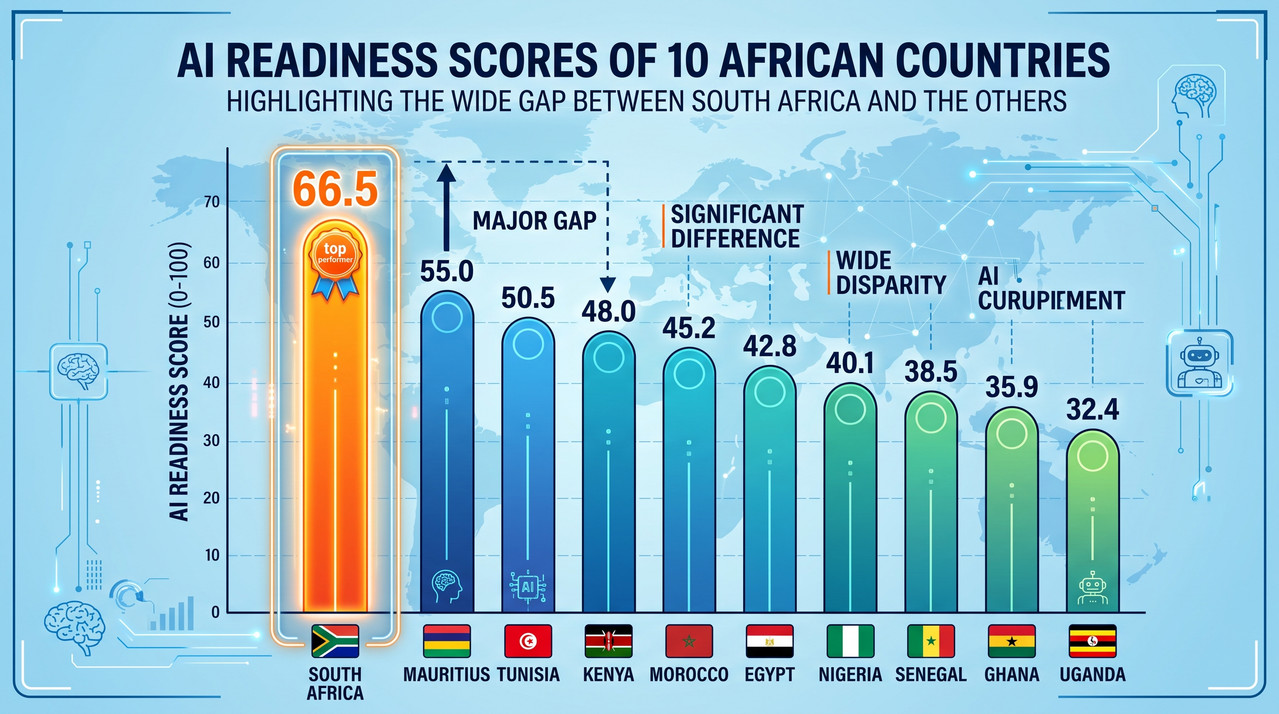
Based on available data from the 2026 Global Outsourcing AI Readiness Index and various national strategy documents, here are Africa's top 10 performing countries in AI readiness and capacity:
| Rank | Country | AI Readiness Score | Key Strengths | Notable Gaps |
|---|---|---|---|---|
| 1 | South Africa | 66.5 | Only African country above global midpoint; enterprise AI adoption score of 65 | Draft AI policy withdrawn in 2026 due to AI-generated fake citations |
| 2 | Nigeria | 49.15 | Highest workforce AI literacy in Africa (66); draft national AI strategy released | Enterprise AI adoption only 34—32-point gap between workforce skills and business deployment |
| 3 | Kenya | 47.6 | Workers rank #3 in Africa on AI literacy; active policy development | Enterprise AI adoption score of 35; stalled Microsoft data center deal |
| 4 | Morocco | 43.35 | Hosted UNECA Conference of Ministers discussing AI; AI factory announced | Enterprise AI adoption score of 39 |
| 5 | Ghana | 42.25 | Workforce AI literacy #4 in Africa (54); draft AI strategy positions AI as "sovereign capability" | Enterprise AI adoption only 31—23-point workforce-enterprise gap |
| 6 | Egypt | Data pending | Has released draft AI policy identifying U.S. dependency as threat; captured 72% of tech funding with top tier | Infrastructure challenges common to North Africa |
| 7 | Rwanda | 19.7 (talent) | Hosted Global AI Summit; Anthropic partnership; Africa AI Council leadership | Small market size limits scale |
| 8 | Uganda | 25.1 | Workforce AI literacy score of 34 | Enterprise AI adoption only 14—among lowest on continent |
| 9 | Ethiopia | 24.2 | Workforce AI literacy score of 33 | Enterprise AI adoption only 14 |
| 10 | Zimbabwe | Data pending | Cassava launched Africa's first AI factory in South Africa with Nvidia | Limited data available on national capacity |
Key Takeaway: There is a sharp divide between Africa's AI leader (South Africa) and the rest of the continent. South Africa is the only country to surpass the 50-point global midpoint, and it outperforms second-ranked Nigeria by a 17.35-point margin—the widest leadership gap in any region covered by the index. Across all seven African countries in the index, the average AI readiness score sits at approximately 42.6, trailing every other major outsourcing region. By comparison, Southeast Asia averages 68.58 and Latin America 62.37.
The Road Ahead: Leverage, Not Independence
The most useful frame for what is happening in Africa right now is not independence. It is leverage. The $60 billion fund buys somewhere between five and ten years to build the institutions, the regional procurement bloc, and the domestic talent base that would make the next round of negotiations look different.
If that window is used well, the Kigali announcement will be remembered as the moment the leverage strategy started compounding. If it is not, the 12,000 GPUs will simply be the most expensive proof yet that naming dependency is not the same as exiting it.
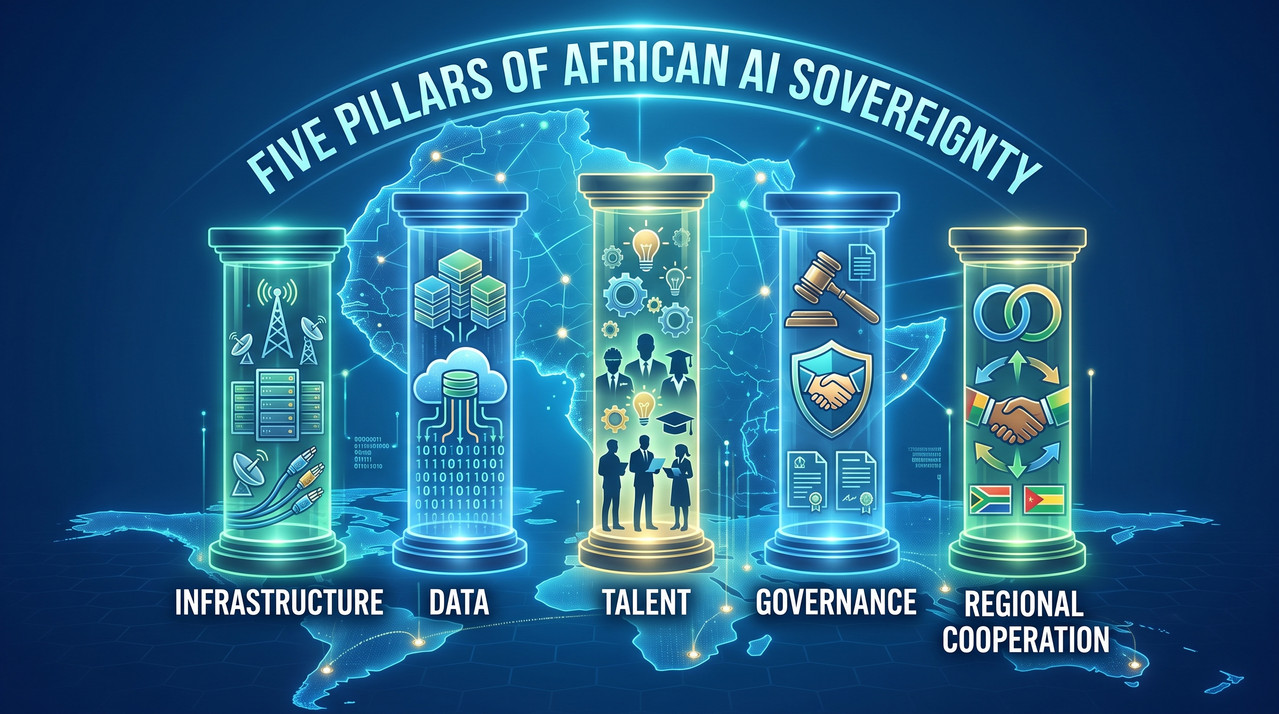
What Meaningful AI Sovereignty Requires
Based on the analysis of experts and policymakers, meaningful AI sovereignty for Africa requires:
- Massive Infrastructure Investment: Closing Africa's infrastructure gap requires an estimated $130–$170 billion annually, with current investment at only $80 billion. Closing the energy gap alone requires $64 billion annually by 2030.
- Data Sovereignty: As Pan-African Parliament President Chief Fortune Charumbira declared, "If we do not control the data that goes into Artificial Intelligence, we will not control the AI that shapes our future. Data sovereignty is not merely a technical issue—it is a matter of human dignity, cultural identity, and Africa's right to define its own development path."
- Indigenous Talent Development: The AI Talent Readiness Index for Africa ranks digital skills with South Africa at 25.85, Kenya 21.65, Rwanda 19.7, and Ghana at 16.0. As Dr. Mahamudu Bawumia, former Vice President of Ghana, noted, "skills gaps remain substantial even where connectivity is improving."
- Regional Coordination: The Africa AI Council and Digital Bandung collective action framework offer pathways to pooled political leverage and shared continental institutions.
- Meaningful Control, Not Just Access: Owning infrastructure is only the start. "It's not just about having control, but having meaningful control."
Conclusion: The Story Africa Must Write
As President Charumbira powerfully stated, "Until the lion learns how to write, the story will always glorify the hunter. Africa must write its own digital story—with African data, African rules, and African values."
The $60 billion AI fund is not the end of Africa's dependency on Big Tech. It is the beginning of a negotiation. It is an acknowledgment that sovereignty in the AI era is not about building everything from scratch—it is about having enough leverage to determine the terms of engagement.
Africa's digital future will not be built in isolation. The continent remains deeply integrated into global technology supply chains and will continue to rely on international investment, expertise, and partnerships. The question facing policymakers is therefore less about whether Africa will use AI than about the terms on which it should do so.
Call to Action: What You Can Do
The $60 billion bet on African AI sovereignty is not just a government initiative. It is a continental project that requires participation from every African citizen, professional, and business leader. Here is how YOU can engage:
For Policymakers
Demand transparency in AI infrastructure deals. Ask your government: "Who owns the data centers? Who manages them? Where is the data stored?" Insist on meaningful control, not just access.
For Business Leaders
Prioritize African-owned technology providers. Build local AI capabilities rather than simply adopting foreign solutions. Invest in training your workforce in AI skills—African workers are ready, but enterprises are lagging.
For Technologists & Developers
Contribute to African language datasets. Build on African-owned infrastructure. Mentor the next generation of AI practitioners. As Dr. Bawumia said, "AI that excludes talent cannot deliver inclusive growth."
For Educators
Modernize curricula to include AI literacy. Expand TVET and apprenticeships for applied data skills. Train public servants for responsible procurement, impact assessment, and oversight.
For Every African Citizen: Demand accountability. As Joseph Asunka, CEO of Afrobarometer, warned, "These negotiations should not just be conducted at the elite level and dumped on citizens. If citizens do not trust their government's actions in this space, it creates a trust gap, which could have negative implications for the adoption of fintech, e-commerce and e-government tools."
The question is not whether Africa will participate in the AI revolution. The question is on whose terms. The $60 billion is the bet. The next five years will determine whether it pays off.

What are your thoughts on Africa's AI sovereignty push? Do you believe the $60 billion fund will create genuine independence, or will it simply deepen dependency on Big Tech? Share your perspective in the comments below, and join the conversation about Africa's digital future.